Today we compiled our board and decided on our final title: "Pistons to protons: An investigation of fuel cells."
This reflects our investigation into the competitiveness of current fuel cell designs in replacing traditional internal combustion engines. Each side of the board displays a different fuel cell type (PEMFC's and SOFC's) and the middle highlights fuel cell design and the collected data, analysis, and conclusion.

Solid Oxide Fuel Cell Research
Today we finished our research on solid oxide fuel cell systems.
Summary
Cathode
Summary
A Solid Oxide Fuel Cell (SOFC) is a type of fuel cell that uses a solid electrolyte as opposed to a liquid or molten electrolyte that other fuel cells use. A lot of development has focused on these types of fuel cells because they are able to handle a wide variety of fuels and do so with a high efficiency (40-60% unassisted, up to 70% in a pressurized hybrid system). However, high efficiency and fuel adaptability are not the only benefits to SOFCs. They are reliable, clean, nearly pollution-free, and have little to no noise pollution since there are little moving parts.
The solid fuel cell
SOFCs are totally solid fuel cells. The anode, cathode, and electrolyte are solid and in order for the cell to function properly, it has to run at high temperatures (600 - 1000°C). Most SOFCs use yttria-stabilized zirconia (YSZ) as an electrolyte because of its low thermal expansion coefficient.
Electrodes:
Anode:
Similarly, the anode has to meet the same requirements as the cathode for electrical conductivity, thermal expansion compatibility and porosity. Most development with the anodes has been focused on nickel because of its abundance and affordability. However, the thermal expansion of nickel (13.3×10⁻⁶/C compared with 10×10-6/C for YSZ) is too high to pair it in pure form with YSZ. To fix this, a composite of nickel and YSZ, Ni-YSZ, is commonly used.
Cathode
Because of the high temperature, platinum catalysts aren’t necessary to carry the reaction through. SOFCs use lanthanum maganite (LaMnO3), typically doped with strontium (Sr) to give a compound called LSM (La1-xSrxMnO3). This material has a similar thermal expansion coefficient to YSZ ( ~10.0×10⁻⁶/C) which means the material won’t change the surface are the hydrogen can bond to very much, as it gets hot.
Advantages:
The advantages of a solid oxide fuel cell are obvious. It can use a wide variety of fuels due to the high temperature that it operates at, its high electrical efficiency (35-45%), and the durability of the parts (the electrolyte, anode, and cathode specifically).
Disadvantages:
The fact that SOFCs operate at such a high temperature provides an issue. This much heat is hard to contain and utilize. Another issue is that this fuel cell takes a long time to warm up to 600°C which is the temperature it needs to reach to be efficient. Another problem is using nickel as an anode. Nickel catalyzes some hydrocarbons into lead, which can build up and clog entrances for hydrogen to catalyze.
More PEMFC Research
Today we finished our research on PEMFC's.
Electrolytic membranes
Electrodes
Catalysts
Annode
Cathode
Disadvantages
CO Poisoning
Cost of Nafion Membrane
Degredation under non-standard conditions
Advantages
Electrolytic membranes
Most PEMFC’s use perflourosulfonic acid-tetrafluoroethylene copolymers (Nafion) as membrane materials with a thickness between 30μm and 100μm (Bruijn, The current status of fuel cell technology for mobile and stationary applications 2005) . Depending on the pressure, the cells can operate at temperatures between 0-90°C.
Since the conductivity of Nafion (normally around 0.1 S cm-1) drops significantly when it is dehydrated, complicated water and heat management systems are necessary in low pressure PEMFC’s (Bruijn, The current status of fuel cell technology for mobile and stationary applications 2005) . The nafion electrolytic membranes, however, are expensive and alternatives have been investigated in order to make such fuel cells commercially competitive. Each alternative contains the sulfonic acid group in order to transport protons, but most lack the durability of Nafion (Breault 2003) .
Electrodes
Catalysts
The only catalysts that have sufficient activity at the operational temperature range are platinum based. These usually contain 20-40% by weight Noble metals and are around 10μm thick in order to avoid resisting the transportation of reactants and protons (Bruijn, The current status of fuel cell technology for mobile and stationary applications 2005) . In order to prevent the formation of CO from CO2, platinum is usually alloyed with ruthenium.
Annode
Usually platinum on carbon electrode is used at the anode, with noble metal content at 0.2 mg cm-2 (Bruijn, The current status of fuel cell technology for mobile and stationary applications 2005) .
Cathode
The cathode is also usually platinum on cathode electrode. Platinum alloys such as PtCr are also used as they often show improved performance (Ralph and Hogarth 2002) . Because water is formed at the cathode, a system for its removal has to be used, otherwise it will block the transport of oxygen and significantly decrease the cell’s performance.
Disadvantages
CO Poisoning
PEMFC’s have a very low tolerance for CO, meaning that a small concentration of CO in the fuel can lead to a large decrease in performance. In the highest quality PEMFC’s, a CO concentration of 10 ppm can lead to a 20-50% loss in power (Bruijn, The influence of carbon dioxide on PEM fuel cell anodes 2002) . Trying to remove CO gas in the presence of CO2 fails as the following reaction is reversed according to Le Chatelier’s principle:
Cost of Nafion Membrane
The Nafion membrane currently costs upwards of $800 per square meter (Lovel and Page 1997) . While some developers are aiming for costs between $30 and $50 per square meter, no alternative has been successfully demonstrated.
Degredation under non-standard conditions
If the fuel cell is subjected to conditions beyond its normal range, it can quickly deteriorate. If a single cell within a stack begins to malfunction due to fuel starvation, pinholes, or excess heat, then the cell material will be used in order to maintain the current of the stack. Thus the individual cell will be quickly degraded and significantly hurt the stack’s performance (Cropper, Geiger and Jollie 2004) .
Advantages
PEMFC’s are best suited for transportation as they have a very low startup time and temperature. This is crucial for cars in order to maintain similar behavior to that of internal combustion engines. Since they can have power outputs in the range of 1 W to 250 kW and have a relatively high power density, they are the fuel cell that is closest to being able to replace petroleum-based engines. These cells can also survive for tens of thousands of hours under normal operations without significantly deteriorating (Bruijn, The current status of fuel cell technology for mobile and stationary applications 2005) .
Fuel Cell Design
Today we worked on the design of an individual fuel cell and its incorporation within a stack system:
Single Cell
Within a single cell, the electrolyte conducts ions between the cathode and anode, and serves as a gas separator and electronic insulator(Bruijn, The current status of fuel cell technology for mobile and stationary applications 2005) . The electrochemical reactions occur at the electrodes, and thus need to contain the appropriate catalysts. In order to have high efficiency, it also needs to be designed such that the rate of transportation of reactants to and from the catalyst-electrolyte interfaces is maximized.
Stack design
The current, at a much higher voltage than possible with a single cell, is then collected at the two end plates.
Single Cell
Within a single cell, the electrolyte conducts ions between the cathode and anode, and serves as a gas separator and electronic insulator
The power produced by a single cell is proportional to the surface area (SA), the current density of the cell (J), and the cell voltage (Vcell) (Bruijn, The current status of fuel cell technology for mobile and stationary applications 2005) :
Since the typical voltage under load conditions is only 0.7 V, a single cell design is unpractical.
Stack design
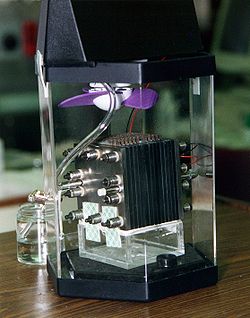
To overcome the low voltages of a single cell design, multiple cells are put in a series connected with flow plates, creating a fuel cell stack. The flow plates are highly conductive and connect the anode of one cell with the cathode of another, while separating the gases of the two cells. These plates contain “flow patterns” to evenly distribute the reactants across the cell, maximizing the surface area of the reaction (Bruijn, The current status of fuel cell technology for mobile and stationary applications 2005) . The stack power and voltage are then proportional to the number of cells contained (n) and the power and voltage of the individual cell:
The current, at a much higher voltage than possible with a single cell, is then collected at the two end plates.
Final Decision on Fuel Cells
At this point in our research we have selected proton exchange membrane fuel cells (PEMFC's) and solid oxide fuel cells (SOFC's) as the primary cells we would like to examine. They are among the most heavily researched and developed designs across the world and will provide the most room for in-depth analysis.
Based upon our research, we have written the following summary of PEMFC's:
Summary
Based upon our research, we have written the following summary of PEMFC's:
Summary
A PEMFC contains a cation-exchange membrane that operates at a temperature of approximately 80°C (Bruijn, The current status of fuel cell technology for mobile and stationary applications 2005) . Since PEMFC’s have a high power density (0.35-0.7 W cm-2) and a quick, cold start is possible at temperatures below 0°C, they are the preferred fuel cells for transportation. More than 90% of all fuel cell vehicles on the road today are equipped with a PEMFC (Cropper, Geiger and Jollie 2004) .
Methanol Alternative
Methanol fuel is highly toxic and a number of alternatives have been researched in order to overcome this. One alternative is a direct-ethanol fuel cell. While still a proton-exchange fuel cell, ethanol liquid is less toxic and has a higher energy density (8.0 kWh/kg vs 61. kWh/kg). The ethanol can be produced from a number of biological sources (sugar cane, wheat, corn, etc).
However, current designs require an expensive platinum-based catalysts, thus making it unpractical in the near future. In order to overcome this, there are projects underway to use nanostructured electrocatalysts that do not contain any precious metals.

However, current designs require an expensive platinum-based catalysts, thus making it unpractical in the near future. In order to overcome this, there are projects underway to use nanostructured electrocatalysts that do not contain any precious metals.

Fuel Cell Type #1: Methanol
The first type of fuel cell we looked at was one based on liquid methanol (CH3OH).

Within such a cell, the following reactions occur:
The advantage of a methanol fuel cell is its energy density. A unit of methanol stores far more energy than highly compressed hydrogen and 15 times more than a lithium ion cell. However, they only provide a small amount of power over a longer period of time. Thus, they can only be used for low-demand devices such as cameras, phones, and laptops, but not high-demand devices like vehicles.
| Anode |  |
|---|---|
| Cathode |  |
| Overall reaction |  |
The advantage of a methanol fuel cell is its energy density. A unit of methanol stores far more energy than highly compressed hydrogen and 15 times more than a lithium ion cell. However, they only provide a small amount of power over a longer period of time. Thus, they can only be used for low-demand devices such as cameras, phones, and laptops, but not high-demand devices like vehicles.
Subscribe to:
Posts (Atom)